

Like Efunsetan, Like Natasha: Power, Gender, and the Politics of Female Authority
By Temilade Aloko
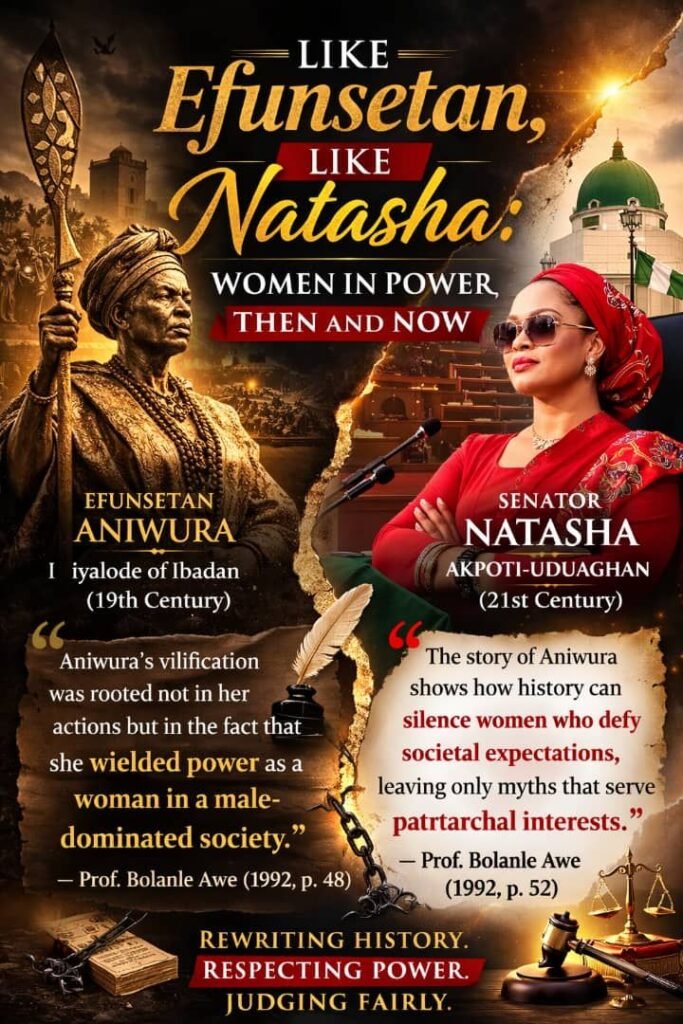
History has rarely been kind to powerful women. Across cultures and centuries, female authority has often been interpreted not as leadership but as defiance; not as strength, but as excess.
In 19th-century Ibadan, Efunsetan Aniwura emerged as one of the most formidable economic and political figures of her time, yet popular memory reduced her largely to the image of a tyrant. More than a century later, women in public life continue to confront strikingly similar patterns of scrutiny and resistance.
The experiences of Senator Natasha Akpoti-Uduaghan invite a reconsideration of how societies construct, challenge, and negotiate female power.
Professor Bolanle Awe, in her pioneering work on Nigerian women’s history, sought to rehabilitate Efunsetan Aniwura’s legacy.
Awe challenged the heavily dramatized and patriarchal narratives that painted Aniwura as cruel, demonic, or ungovernable. Her research revealed a different truth: Efunsetan was a wealthy, influential trader and the second Iyalode of Ibadan, wielding substantial authority in a male-dominated society. Awe argued that the negative portrayals were less a reflection of Aniwura’s character and more an expression of societal discomfort with a woman in power. As Awe observes, “Aniwura’s vilification was rooted not in her actions but in the fact that she wielded power as a woman in a male-dominated society” (Awe, 1992, p. 48).
Authority, when exercised by a woman, was often recast as tyranny.
Awe’s scholarship highlights several important points. First, Efunsetan’s power was real and structural, not imagined. She managed people, wealth, and influence in ways that rivaled many men of her era. Second, the vilification of her legacy was gendered, stemming from a patriarchal society uneasy with female leadership.

Finally, Awe’s meticulous documentation provided a counter-narrative to oral traditions, dramatic plays, and popular history that had long framed Aniwura as a cautionary tale against women exercising authority.
Fast forward to the 21st century: women like Senator Natasha navigate a world of formal legal frameworks, global human rights advocacy, and the democratizing power of social media. Yet the patterns are familiar. Assertiveness is still often read as aggression; ambition, as impropriety. Visibility invites scrutiny, and success can provoke hostility.
Unlike Aniwura, contemporary women have access to tools that allow them to contest false narratives, mobilize public opinion, and seek legal redress. Social media, laws protecting gender equality, and global discourse on women’s rights create channels through which women can demand justice and representation.
The comparison between Aniwura and Natasha is not about equating circumstances but about revealing enduring societal dynamics.
In Aniwura’s time, oral traditions and dramatized history shaped her memory; today, digital media and political discourse perform similar functions. In both eras, women who occupy positions of power are sites of moral and political judgment. Yet whereas Natasha can respond, intervene, and challenge misrepresentation, Aniwura had no recourse beyond her immediate social and political influence—a sphere ultimately constrained by patriarchal structures.
One is compelled, therefore, to ask: Would Efunsetan Aniwura have been remembered differently if she had lived in an era that permitted women to control their own narratives? Awe underscores this dilemma:
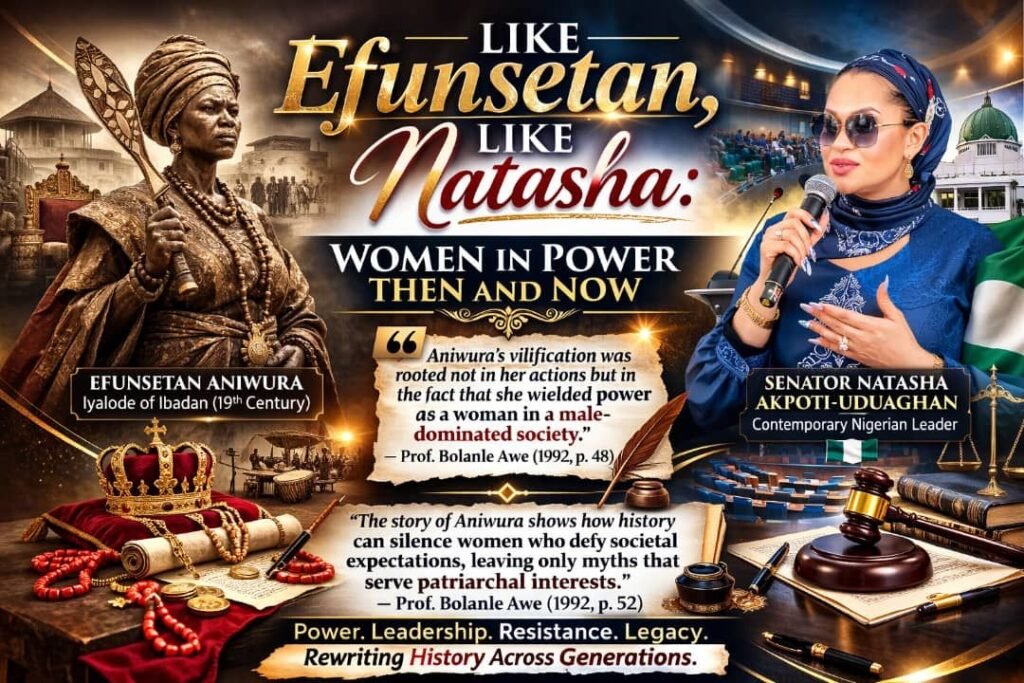
“The story of Aniwura shows how history can silence women who defy societal expectations, leaving only myths that serve patriarchal interests” (Awe, 1992, p. 52).
Perhaps the tragedy of her story lies not solely in her actions or her authority but in the absence of mechanisms to record, defend, and contextualize her legacy.
The distance between 19th-century Ibadan and modern Nigeria is vast in technology, law, and political organization. Yet the unease surrounding female authority persists in subtler forms. Revisiting Efunsetan Aniwura through Awe’s scholarship does more than rehabilitate a historical figure; it compels contemporary society to interrogate its own reflexes.

The question is no longer whether women can attain power, but whether power itself can be perceived without the distortions of gendered expectation.
Efunsetan Aniwura and Natasha Akpoti-Uduaghan, though separated by centuries, are linked by more than their gender. They are connected by a societal tendency to scrutinize, vilify, and challenge women in authority. Understanding this continuum is not only an act of historical correction but also a call to cultivate a society that can respect and judge women leaders fairly—past, present, and future.
References / Acknowledgement
Awe, Bolanle. Women and Nigerian History. Ibadan: University Press, 1992.
About The Author








You’re going places my dear young lady Temilade. I so much love your comparison between Efunsetan Aniwura and Senator Natasha Akpoti Uduaghan. Though centuries apart their will power and resolves plus determination to uplift womanhood are one and the same. This has been confirmed by historical evidences..Thanks. I wish you more successes. More Anointing and more blessings
thank you sir